Architectural visualization stands at a crossroads. Over the last few years, we’ve mastered using AI to generate images (Midjourney, Stable Diffusion). That was Phase 1. But in 2026, simply making pretty pictures isn't enough.
The market demands speed, absolute data sovereignty, and process intelligence.
That is why at Twobuild, we are radically restructuring our infrastructure. We are moving away from passive tools and embracing Agentic AI. At the center of this revolution lies one tool: OpenClaw.
The Problem: The "Zero-Click" Trap
We all know the paradox: Rendering engines are getting faster (thanks to Unreal Engine 5 & Lumen), but the administrative burden is exploding.
- Searching for & sorting files.
- Communication ping-pong.
- Monitoring render farms at 3 AM.
In traditional studios, this "non-creative" grunt work eats up to 40% of billable time. That is time we cannot invest in your design.
The Solution: OpenClaw Is Not a Chatbot, It’s a Digital Employee
Don't confuse OpenClaw with ChatGPT. ChatGPT is a conversationalist inside a "walled garden." OpenClaw is an agent with hands.
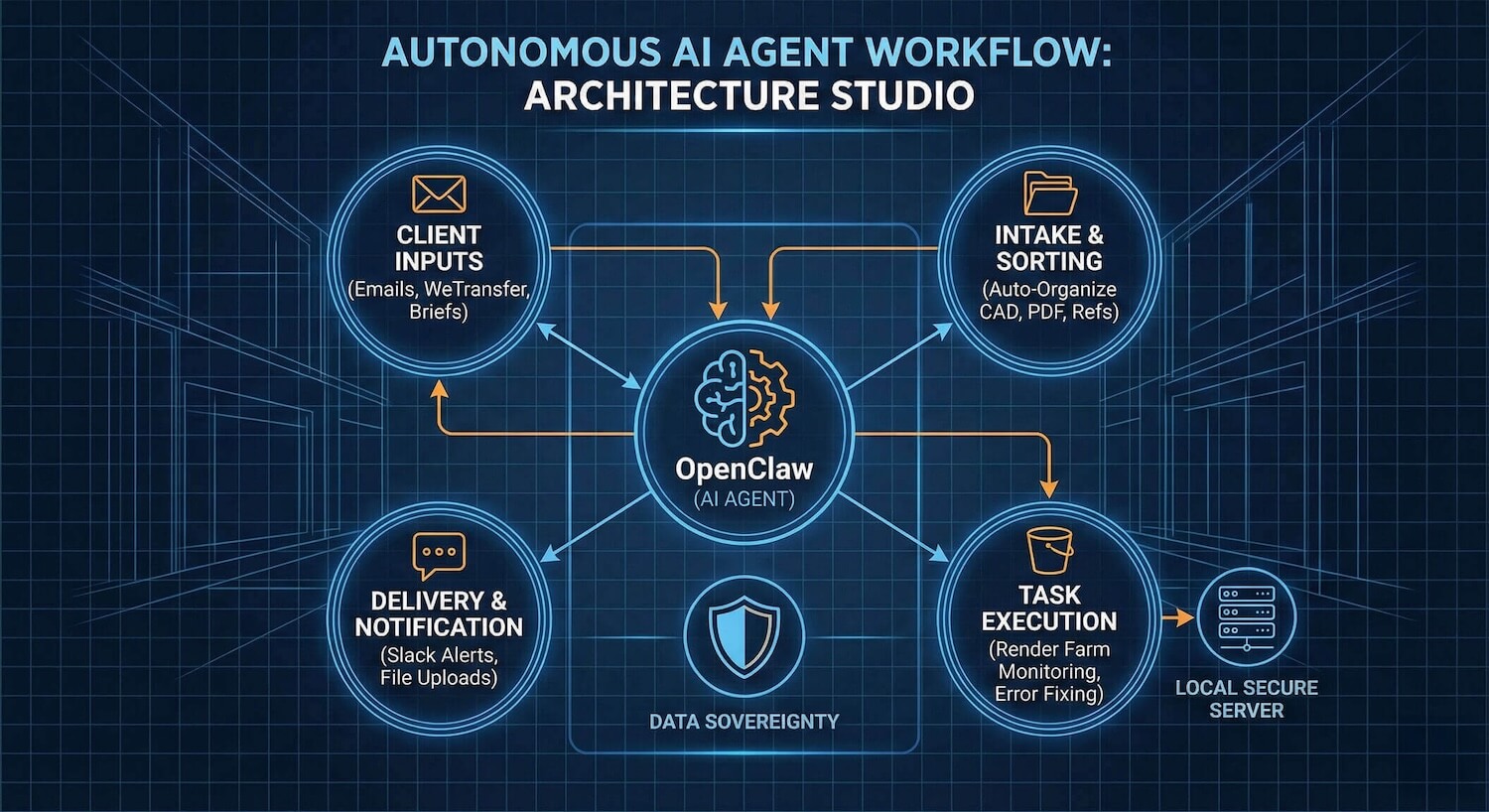
Think of OpenClaw as a digital project manager living on our local hardware (Mac Studio Cluster). It doesn't just "think"—it acts. It has read/write access to our file system, browser, and render pipeline.
Why "Sovereign AI" Is Vital for Architects
The biggest barrier to AI adoption in architecture is Intellectual Property (IP). No one wants to upload the unreleased floor plans of a €100M development into a cloud-based AI.
OpenClaw allows us to adopt a "Local-First" approach:
- Data Sovereignty: The agent runs locally on our servers in Vienna. No uploads to US clouds.
- Hybrid Intelligence: Sensitive data (floor plans, budgets) are processed by local models (like Llama 3). Your data never leaves the building.
- Physical Access: The agent can actually organize files, not just talk about them.
3 Ways Agentic AI Accelerates Your Projects
We don't use this technology just for the sake of it; we use it to hit your deadlines.
1. The Autonomous "Intake Coordinator"
The Scenario: You send us a WeTransfer link with 50 unsorted DWGs and PDFs for a competition entry late on a Friday night.
- Without Agent: We see it Monday morning, spend an hour downloading and sorting. Valuable time lost.
- With OpenClaw: An "Email Watcher" skill detects the link, downloads the assets overnight, unzips them, and sorts them automatically (
/CAD,/Docs,/Refs). When we arrive on Monday, everything is ready to go.
2. The "Render Watchdog" (24/7 Monitoring)
The Scenario: A 4K animation render fails at 03:00 AM because of a missing texture.
- Without Agent: 6 hours of render time lost. Deadline at risk.
- With OpenClaw: The agent polls the farm every 15 minutes. It detects the error ("Missing Asset"), locates the file on our local network, uploads it, and restarts the job. Zero human intervention required.
3. The "Trend Scout"
Our agents continuously scan architectural RSS feeds (ArchDaily, Dezeen). When new building regulations or sustainability trends emerge, we know immediately. We can proactively adapt our visualizations to match current market demands—often before you even brief us.
Technical Deep Dive: Under the Hood
For the Tech Leads and BIM Managers among our clients: We run OpenClaw in a containerized Docker environment.
This ensures maximum security through "sandboxing." The agent is powerful, but strictly controlled. Here is a simplified example of our TypeScript logic for error detection:
TypeScript
`// Twobuild Render-Monitor Skill (Simplified)if (renderJob.status === 'FAILED') {// 1. Retrieve error logconst errorLog = await renderFarm.getLog(jobID);
// 2. Analyze error locally (No Cloud involved)const fixStrategy = await localAI.analyze(errorLog);
// 3. Alert team (only for critical failures)if (fixStrategy.isCritical) {await telegram.notifyDev(⚠️ Critical: Job ${jobID} failed via OpenClaw.);}}`
Conclusion: Performance Through Process Intelligence
The hype around "generative AI images" is flattening. The future belongs to agents that get work done.
For you as a client, our shift to OpenClaw means:
- Higher Data Security (Sovereign AI).
- Faster Response Times (Background automation).
- Focus on Quality (We invest our time in design, not file management).
At Twobuild, we are ready for the Agentic Era. Are you?

Sell Faster. Impress More. Close Deals with Stunning Architectural Renderings.
Join top real estate professionals and developers using high-end visualizations to attract buyers and close deals with confidence.